- How many days in Tunis
- 3 days to see the essentials of Tunis; the day-by-day route is below.
- From the airport
- Tunis-Carthage Airport is only about 8 km from the centre.
- Where to stay
- It is 30-40 minutes from the centre by TGM.
- What to eat
- Friday is the traditional couscous day.
Tunis is not a pretty postcard city, and that is part of the appeal. The UNESCO-listed medina is one of the best-preserved in North Africa, and you will walk it with locals doing their shopping rather than tour groups. Around it sits a slightly shabby French colonial centre, and a short train ride away you reach the Roman ruins of Carthage and the blue-and-white cliffside village of Sidi Bou Said. Prices are low by European standards and flights from much of Europe are short and often cheap. Most first-time visitors underestimate the place.
It suits travellers who like history, food and a bit of friction: some hassle in the souks, taxis that need a nudge to use the meter, and a capital that is relaxed but very much a working city. If you want beach resorts, head to Hammamet instead. Three days is the right amount of time: one for the medina and centre, one for Carthage and Sidi Bou Said, and one for the Bardo plus either a day trip or a slow morning in La Marsa.
What to see in Tunis: the places worth your time
The Medina of Tunis
The medina is the main reason to come: around 700 monuments packed into a maze of covered souks, palaces and mosques. Enter through Bab el Bhar (the old Porte de France) and follow Rue Jamaa Zitouna uphill. Give it at least half a day. Walking around is free. Our tip: go mid-morning on a weekday when the shops are open. On Sundays much of it is shuttered and the place feels oddly empty.
Zitouna Mosque
The Great Mosque of Zitouna dates from the 8th century and sits at the medina's centre. Non-Muslims cannot enter the prayer hall, but they are usually allowed to look into the courtyard from a designated area in the morning, for a small fee (about €2-3, 7-10 TND). Dress modestly with shoulders and knees covered. Fifteen minutes is enough, so combine it with the souks around it.
The souks: Attarine, Chechias and Trouk
The souks fan out around the mosque by trade. Souk el Attarine sells perfumes and essential oils. Souk des Chechias is where craftsmen still make the red felt chechia hats, and it is the most authentic stretch. Souk et Trouk is where you will find carpets and Café M'Rabet. Plan 1-2 hours. Haggling is expected in the tourist souks but not in the food shops.
Rooftop views over the medina
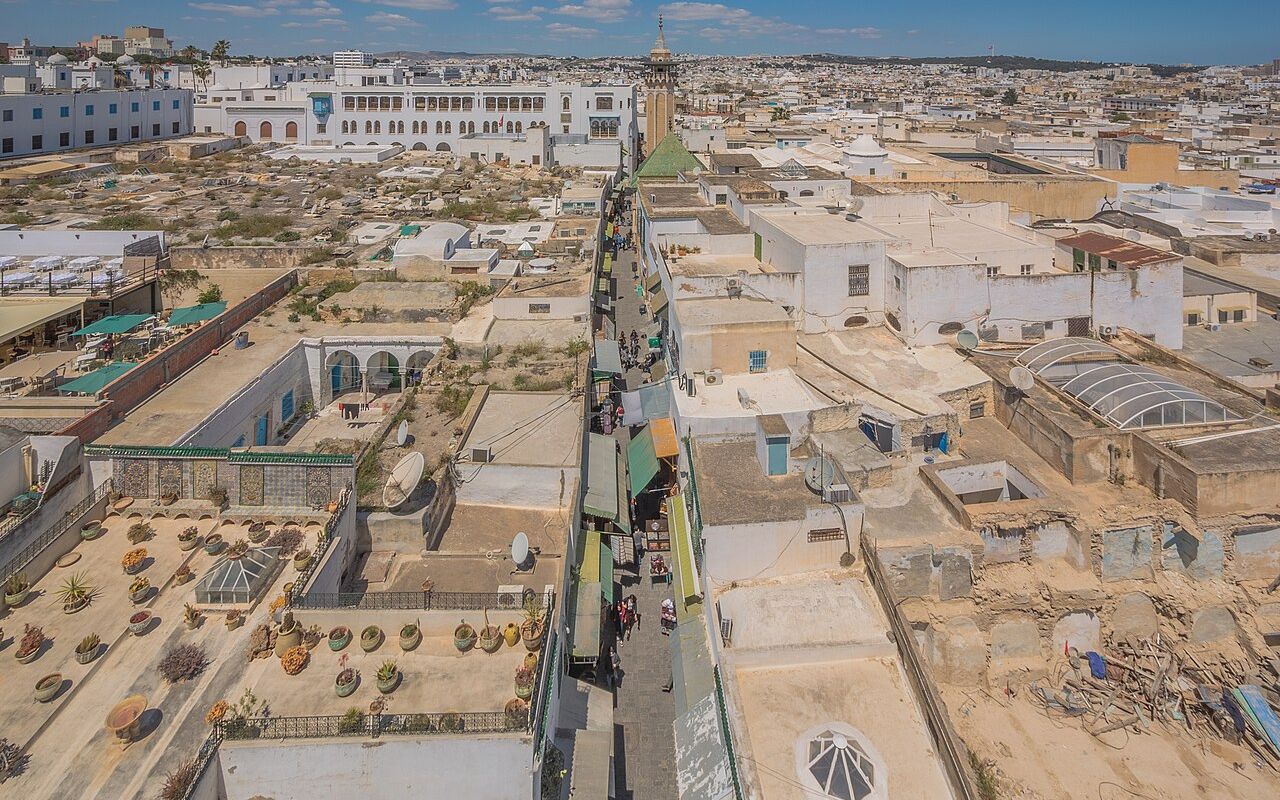
The best views of the medina come from the rooftops. Several cafés and shops around Souk et Trouk let you up for the price of a mint tea, and the terrace above the Ali café/restaurant area is a reliable choice. The view takes in the Zitouna minaret, green-tiled roofs and, on a clear day, the lake. Go late afternoon for softer light.
Dar Ben Abdallah and Tourbet el Bey
These are two of the medina's best interiors, both in the quieter southern half. Dar Ben Abdallah is an 18th-century palace that now houses a small folk-arts museum, with tiled courtyards and painted ceilings. Tourbet el Bey is the domed mausoleum of the Husseinite beys, covered in marble and ceramics. Each costs a few dinars (around €1-3) and takes 30-45 minutes. Check the hours before you go, because they shut earlier than you would expect.
Bardo National Museum
The Bardo holds the world's finest collection of Roman mosaics, housed in a former beylical palace. The Virgil mosaic and the huge marine scenes alone justify the trip. It closed for a long period in recent years, so check its current status before you plan around it. When it is open, allow 2-3 hours and expect a ticket of roughly €4-6 (13-20 TND). Light rail line 4 stops nearby, or take a taxi from the centre for about €2.
Avenue Habib Bourguiba
This tree-lined boulevard is the spine of the colonial Ville Nouvelle, running from the medina gate to the clock tower. It works best as a walk combined with café-sitting: Art Nouveau facades, the Théâtre Municipal and pavement terraces full of men drinking espresso. Allow an hour, and walk it in the early evening when the city comes out.
Cathedral of St Vincent de Paul
This odd neo-Romanesque, Byzantine-flavoured cathedral faces the French embassy on Avenue Habib Bourguiba. It is worth ten minutes for the facade and a look inside if the doors are open. It is free.
Carthage: Byrsa Hill and the Antonine Baths
Ancient Carthage is spread across a suburb, not in one site, which disappoints people expecting a Pompeii. The two highlights are Byrsa Hill (with the Carthage Museum and the view over the Gulf of Tunis) and the seafront Antonine Baths, once among the largest in the Roman world. A single combined ticket of roughly €4-7 covers the main sites. Take the TGM train to Carthage Hannibal for Byrsa and Carthage Salammbô for the Punic Ports and Tophet. Allow 3-4 hours and wear proper shoes.
Punic Ports and the Tophet
These are the quieter Carthage sites, and they are worth it if you care about the Phoenicians rather than the Romans. The circular military harbour is still visible as a lagoon. The Tophet is a moody, overgrown sanctuary with child burial urns and a disputed history. Each takes 30 minutes and is covered by the combined ticket.
Sidi Bou Said
Sidi Bou Said is the whitewashed village with blue doors and bougainvillea that appears on every Tunisia cover. Yes, it is touristy, and yes, it is still lovely. Climb to Café des Délices for a mint tea with pine nuts over the bay, and visit Dar Ennejma Ezzahra, Baron d'Erlanger's palace, for its music and interiors (a few euros). Get a warm bambalouni (sugared doughnut) from the stalls on the main street. Arrive early or stay for sunset to avoid the coach-tour midday crush.
La Marsa
La Marsa is the TGM's last stop: a breezy seaside suburb with a beach, a corniche and good cafés. Café Saf Saf, with its old well turned by a camel, is a local institution. It is the place to see how middle-class Tunisians actually spend a weekend. Give it a relaxed half day.
Things to do in Tunis
Beyond the monuments, these are the experiences that make a Tunis trip stick.
- Go to a hammam. The medina still has working neighbourhood bathhouses, with separate hours or buildings for men and women. A scrub with a kessa glove costs a few euros. Bring flip-flops and something to wear.
- Eat lablabi for breakfast. This chickpea and cumin soup is poured over torn bread with harissa, an egg and tuna. Look for a busy hole-in-the-wall near the Marché Central.
- Browse the Marché Central. The covered market off Rue Charles de Gaulle has fish, olives, spices and harissa pastes. Go in the morning.
- Ride the TGM. The rickety commuter train crosses the lake on a causeway with flamingos sometimes visible. The trip is half the fun.
- Catch malouf music. Andalusian-rooted classical music is performed at Dar Ennejma Ezzahra and during summer festivals in Carthage and Hammamet.
- Buy chechias, ceramics or perfume oils. Prices fall fast once you show you know the going rate.
- Watch the sunset from Belvédère Park. This hilly park north of the centre is where families come in the evening.
Tunis for free (or almost)
A lot of Tunis costs nothing, and the rest is cheap.
- Walking the medina, the souks and Avenue Habib Bourguiba is free.
- Sidi Bou Said's streets and viewpoints are free. Only the café and the palace museum cost anything.
- The TGM to Carthage or La Marsa costs well under €1 (around 1-2 TND).
- Rooftop views cost a mint tea, about €1-2.
- The beaches at La Marsa and Gammarth are free if you skip the hotel sunbeds.
- A sandwich tunisien or a plate of lablabi costs €1-2. Eating cheaply here is easy.
Tunis itinerary: 3 days
| Day | Morning | Afternoon | Evening |
|---|---|---|---|
| Day 1 Medina and the colonial centre | Have lablabi or coffee near the Marché Central, then walk up Avenue Habib Bourguiba to Bab el Bhar. Enter the medina and head up Rue Jamaa Zitouna to the mosque courtyard. | Explore the souks (Attarine, Chechias, Trouk), eat lunch in the medina, then walk south to Dar Ben Abdallah and Tourbet el Bey. Finish with tea on a rooftop. | Stroll the avenue at dusk and eat dinner in the Ville Nouvelle, or book Dar El Jeld for a splurge in a medina palace. |
| Day 2 Carthage and Sidi Bou Said | Take the TGM from Tunis Marine to Carthage Salammbô. Walk the Tophet and Punic Ports, then continue to the Antonine Baths. | Climb Byrsa Hill for the museum and the view, then hop back on the TGM two stops to Sidi Bou Said. | Have sunset tea at Café des Délices, then eat dinner in Sidi Bou Said or one stop further in La Marsa. |
| Day 3 Bardo and La Marsa (or a day trip) | Visit the Bardo Museum if it is open. Go first thing for the mosaics without crowds. | Take the TGM to La Marsa for the beach, Café Saf Saf and a seafood lunch. | Return to the centre for a final brik and a walk. If the Bardo is closed, swap the day for Dougga or Kairouan. |
What is overrated (and what to do instead)
- Carthage as a single "ancient city". It is scattered ruins in a residential suburb, and much was destroyed by the Romans and later quarried. For a complete Roman town, go to Dougga, which is far more impressive.
- Midday in Sidi Bou Said. Between roughly 11am and 4pm it is coach groups and selfie queues on one street. Go at 9am or for sunset instead.
- Carpet shop "free rooftop views". The view is real, but the pitch that follows is long. Use a café terrace instead.
- Les Berges du Lac. Some guides push this glassy business district. It is malls and chain cafés, so skip it unless you need a modern hotel.
When to visit Tunis
The best months are April-June and September-October: warm (20-28°C), sunny and ideal for walking ruins. July and August are hot (often 33°C or more), Carthage turns into an oven, and hotels near the beach raise prices, although this is festival season. Winter (December-February) is mild but grey and rainy at times. It is the quietest and cheapest period, and it is fine for museums and the medina.
Check the dates of Ramadan. Daytime restaurants close and opening hours shrink, but evenings are lively. Flight deals from Europe tend to be best in November, January-March and early June.
Where to stay in Tunis: best areas
- Ville Nouvelle (around Avenue Habib Bourguiba): The most practical base, close to the medina, the TGM at Tunis Marine and the light rail. Hotels are dated but well placed. Expect €35-80 a night.
- The Medina: Restored dar guesthouses around courtyards, full of atmosphere. The lanes are dead quiet at night, which some people love and others find eerie. Expect €60-150.
- Sidi Bou Said: Romantic and calm after the day-trippers leave, with sea views. It is 30-40 minutes from the centre by TGM. Expect €70-180.
- La Marsa: Best for a seaside, local feel, good restaurants and the beach. Expect €40-120.
- Gammarth: Resort hotels with pools north of La Marsa, good for beach-plus-city trips with a car or taxi budget. Expect €80-200.
What to eat in Tunis
Tunisian food is spicy, olive-oil heavy and very good value. Harissa comes with everything, often with bread before the meal.
- Brik à l'oeuf: A crisp fried pastry with a runny egg, tuna and parsley. Eat it with your hands and lean forward.
- Lablabi: The chickpea soup that works as breakfast and as a hangover cure.
- Couscous: Often with fish in coastal places or lamb inland. Friday is the traditional couscous day.
- Ojja: Eggs poached in a spicy tomato and pepper sauce, often with merguez.
- Kafteji: Fried vegetables chopped with egg, a street-food classic.
- Fricassé and makloub: A fried sandwich roll and a folded pizza-like wrap, both cheap fillers.
- Mloukhia: A dark, slow-cooked stew of ground jute leaves. It is an acquired taste, but very Tunisian.
- Grilled fish in La Marsa: Choose it by weight, so ask the price before it goes on the grill.
- Mint tea with pine nuts and bambalouni: The Sidi Bou Said combination.
A street lunch (sandwich or lablabi plus a drink) costs about €2-4 (7-14 TND). A sit-down lunch with a main and a salad costs €6-10. Dinner in a decent mid-range restaurant runs €12-20 a head. Dar El Jeld and similar palace restaurants cost €30-45. Alcohol is served in licensed restaurants and hotels and is pricier than food, with a local Celtia beer at about €2-4.
Airport to city centre and getting around
Tunis-Carthage Airport is only about 8 km from the centre. A taxi takes 15-25 minutes and should cost roughly €5-8 (15-25 TND) on the meter. Yellow taxis waiting outside often quote much more, so insist on the meter or walk to the departures level and flag one being dropped off. Bolt also operates in Tunis and gives you a fixed price. City buses run from the airport to the centre for well under €1, but they are irregular and crowded, so they only make sense with light luggage.
- TGM train: Runs from Tunis Marine to La Goulette, Carthage, Sidi Bou Said and La Marsa, about 30-40 minutes end to end, for 1-2 TND.
- Metro léger (light rail): Several lines radiate from Place Barcelone and République. Useful for the Bardo. Each ride costs under €0.50.
- Taxis: Cheap and everywhere. Most rides in the city cost €1.50-4. Always check that the meter is on.
- Louages: Shared minibuses for intercity trips that leave when full, from stations like Moncef Bey.
There is no tourist travel pass worth buying. Single tickets are so cheap that it does not matter.
How much a trip to Tunis costs
| Level | Per person per day | What it covers |
|---|---|---|
| Shoestring | €30-45 a day | Simple hotel or hostel (€20-30), street food (€6-8), TGM and light rail (€1-2), one paid site (€3-5). |
| Mid-range | €80-130 a day | Medina dar or good centre hotel (€60-90), sit-down meals (€20-30), taxis (€5-10), museums and Carthage (€8-12). |
| Comfort | €180+ a day | Boutique dar or Sidi Bou Said hotel, palace dinners, private guide or driver. |
Day trips from Tunis
- Dougga: The best-preserved Roman town in North Africa, with its theatre, Capitol and houses on a hillside of olive groves. It is about 2 hours by car. Without a car, take a louage to Téboursouk and a taxi up. A driver for the day costs about €60-90.
- Kairouan: Tunisia's holiest city, with the Great Mosque and the Aghlabid Basins. Try a makroudh (date pastry). It is around 2-2.5 hours by louage.
- Hammamet and Nabeul: Beach, a small medina and Nabeul's pottery shops. About 1-1.5 hours by louage or train.
- Bizerte: A pretty old port with a fishing harbour and a kasbah, about 1-1.5 hours by louage. A good half day.
- Zaghouan: The Water Temple that fed Carthage's aqueduct, with mountain views. About 1 hour by car, best combined with the aqueduct remains on the way.
Common mistakes and scams
- The "Berber festival" or "special market today" line. A friendly man tells you the mosque is closed but there is a one-day-only event, then walks you to a carpet shop. Smile and keep walking.
- Unmetered taxis. Especially at the airport and in Sidi Bou Said. Ask for the meter ("compteur") before you get in, or use Bolt.
- Unpriced fish. Ask for the price per kilo and the weight before it is cooked.
- Unofficial guides. Kids and men offering to show you the way in the medina expect payment. Politely decline, or agree a price upfront.
- Currency. The Tunisian dinar is a closed currency. You cannot reliably buy it abroad, so withdraw from ATMs on arrival, keep exchange receipts and spend or change most of it before leaving.
- Visiting on Sunday. The souks mostly shut, so plan your medina day for a weekday.
- Dressing for the beach in the medina. It is not illegal, but covered shoulders and knees get you less hassle and are needed for religious sites.
Tunis FAQ
How many days do you need in Tunis?
Three days covers the medina, Carthage, Sidi Bou Said and the Bardo comfortably. Add a fourth or fifth day for Dougga or Kairouan.
Is Tunis safe for tourists?
Tunis is generally safe for visitors, with petty hassle and overcharging the main issues. Check your government's travel advice before going and avoid demonstrations.
Is Tunis worth visiting?
Yes, especially if you like history and food. The medina, Roman mosaics and Sidi Bou Said make a strong, cheap city break that few people take.
How do you get from Tunis to Sidi Bou Said?
Take the TGM train from Tunis Marine to the Sidi Bou Said stop, about 30 minutes and under €1. A taxi takes 20-30 minutes and costs around €5-8.
Can you visit Carthage and Sidi Bou Said in one day?
Yes. Do Carthage in the morning and early afternoon, then take the TGM two stops on to Sidi Bou Said for sunset.
Do I need to speak French in Tunis?
French is widely spoken alongside Tunisian Arabic, and English works in hotels and tourist areas. A few French phrases help with taxis and markets.
What currency is used in Tunis and can I pay by card?
The currency is the Tunisian dinar (roughly 3.3-3.5 TND to €1). Cards work in hotels and better restaurants, but carry cash for taxis, markets and street food.
What should I wear in Tunis?
Light, modest clothes covering shoulders and knees for the medina and mosques. Beachwear is fine at La Marsa and Gammarth.
What to see in Tunis in two days?
With two days, follow days 1 and 2 of this itinerary. Day 1: Medina and the colonial centre. Morning: Have lablabi or coffee near the Marché Central, then walk up Avenue Habib Bourguiba to Bab el Bhar. Day 2: Carthage and Sidi Bou Said. Morning: Take the TGM from Tunis Marine to Carthage Salammbô.
What to do in Tunis in 3 days?
With three days in Tunis, this is the guide's route: Day 1, Medina and the colonial centre; Day 2, Carthage and Sidi Bou Said; Day 3, Bardo and La Marsa (or a day trip). The table above has the full plan for each day.
What to see in Tunisia in 3 days?
With three days in Tunisia, this guide suggests staying in Tunis and following its route: Day 1, Medina and the colonial centre; Day 2, Carthage and Sidi Bou Said; Day 3, Bardo and La Marsa (or a day trip).
Where to stay in Tunis?
It is 30-40 minutes from the centre by TGM. The 3 hotels with the best real guest scores, according to top3hotels.com, are budget: Hotel karim Tunis (La Medina, score 8.6, from €44 a night); best value: Dar El Médina (La Medina, score 9, from €93 a night); luxury: Dar El Jeld Hotel and Spa (La Medina, score 9.4, from €193 a night). The nightly price is indicative and changes with the dates.
How do you get from the airport to central Tunis?
Tunis-Carthage Airport is only about 8 km from the centre.
How do you get around Tunis?
Yellow taxis waiting outside often quote much more, so insist on the meter or walk to the departures level and flag one being dropped off.
What are the must-see places in Tunis?
According to this guide: The Medina of Tunis; Zitouna Mosque; The souks: Attarine, Chechias and Trouk; Rooftop views over the medina; Dar Ben Abdallah and Tourbet el Bey; Bardo National Museum; Avenue Habib Bourguiba; Cathedral of St Vincent de Paul. Each one is explained in the "What to see" section.
Is Tunis expensive?
It depends on how you travel. This guide puts the "shoestring" level at about €30-45 per person per day and the "comfort" level at about €180+. Flights are extra: this page shows real fares checked by Happy Low Cost.
Photo: IssamBarhoumi · CC BY-SA 3.0 · Wikimedia Commons · Guide updated 21 Nov 2026